Retail Store Fit-Out Dubai: The Proven, Essential Checklist
A retail store fit-out Dubai project involves far more than choosing finishes and fixtures.Layout, lighting, mall compliance, and back-of-house planning all have to come together before a single rail of stock goes up — and getting any one of them wrong can mean lost sales from day one, lengthy compliance delays, or a store that looks great on opening day but struggles to adapt six months later. This checklist walks through the essentials to plan for, whether it’s a first store or an expansion into a new mall.
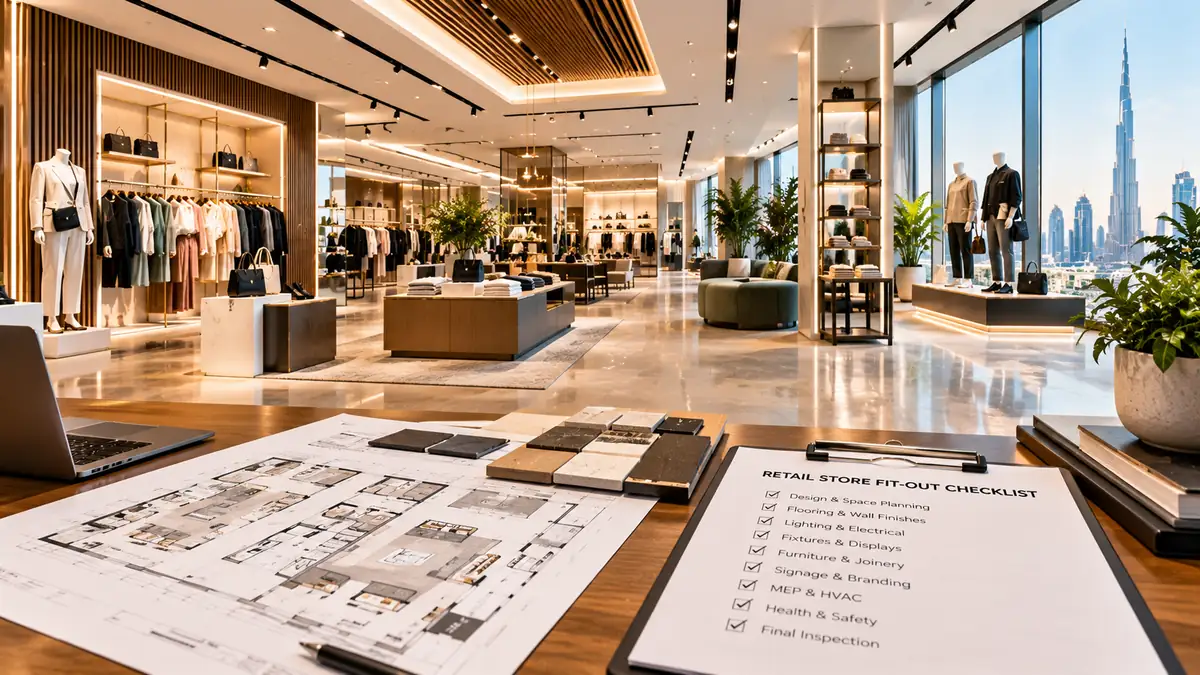
Retail Store Fit-Out Dubai: Start With Layout and Customer Flow
Every successful retail store fit-out Dubai project begins with how customers move through the space. A well-planned layout guides footfall naturally toward high-margin products, avoids dead zones, and keeps the checkout area from becoming a bottleneck. Grid, loop, and free-flow layouts each suit different store types — a grid layout suits high-volume stock-heavy retail, while a free-flow layout works better for boutique or premium brands where browsing time matters more than throughput. For more depth on how layout shapes customer behavior, Shopify’s retail layout guide is a useful reference point.
Lighting and Visual Merchandising
Lighting does two jobs at once: it makes products look their best, and it shapes how long customers linger. Layered lighting — ambient, accent, and task lighting working together — consistently outperforms a single flat light source for both mood and merchandising impact. Visual merchandising zones (window displays, entrance tables, feature walls) should be planned into the fit-out from the start, not added as an afterthought once shelving is in place.
Fitting Rooms and Checkout Placement
For fashion and apparel retail, fitting room quality directly affects conversion — poor lighting or cramped fitting rooms are a common reason customers abandon a purchase. Checkout placement matters just as much: it should be visible from most of the store without creating a queue that blocks the main customer path.
Mall Compliance and Signage Standards
Most Dubai retail fit-outs happen inside malls, which means every design decision also has to clear the mall’s own fit-out guidelines — signage dimensions, shopfront design, fire and life-safety requirements, and approved contractor lists. Missing a single compliance requirement can delay a store opening by weeks, so this should be confirmed before design finalization, not discovered during submission.
Storage and Back-of-House Planning
Back-of-house space is easy to under-plan, but it directly affects how efficiently staff can restock the shop floor. Storage layout, staff facilities, and delivery access all need dedicated space in the plan — a strong shop floor design means little if the stockroom behind it can’t keep up.
Flexibility for Seasonal and Promotional Changes
A retail store fit-out Dubai project should also plan for change, not just opening day. Retail environments need to adapt quickly for seasonal collections, promotional campaigns, and Dubai’s major shopping events — Dubai Shopping Festival and similar periods drive significant footfall spikes that a static layout can struggle to handle. Modular fixtures, flexible display zones near the entrance, and electrical/lighting provisions that support temporary signage all make it easier to refresh a store’s look without a full renovation each time. Planning this flexibility into the original fit-out is far more cost-effective than retrofitting it later once the store is already trading.
One Contractor, Fewer Delays
A retail store fit-out Dubai project moves faster when design, MEP, and construction are handled under one contractor rather than split across multiple vendors. Mall compliance submissions, signage approvals, and construction sequencing all need to stay coordinated — something far easier to manage with a single team accountable for the full process. Explore River Island’s full range of fit-out services or get in touch to discuss a retail project.
Frequently Asked Questions
Timelines vary by store size and mall requirements, but most retail store fit-out Dubai projects move through design and mall approvals, then construction and MEP, followed by fixtures and final snagging — smaller units typically move faster than larger-format stores.
Yes. Most Dubai malls require fit-out drawings to be submitted and approved against their own guidelines before construction begins, covering signage, shopfront design, and fire/life-safety compliance.